

Governed AI Solutions with
Human Oversight Built In
ISO 9001 | ISO 27001 | CMMI Level 5 | Inc. 5000 Certified
Governed AI Services Built Around Your Business Outcomes

Industry-Specific AI
AI built for your sector’s rules, data, and workflows. Financial services teams use it for risk scoring and AML compliance. Healthcare organizations use it for clinical decision support under HIPAA. Casino operators use it for player analytics and responsible gambling. Every model reflects how your industry actually works.
See the tech stack

Department-Ready AI
AI embedded in the tools your teams already use. Sales teams get AI-assisted forecasting inside Salesforce. HR gets intelligent screening workflows. IT gets ticket routing and resolution agents. Finance gets anomaly detection in reporting pipelines. Adoption happens fast because the AI meets people where they work.
See the tech stack

Enterprise AI Orchestration
The connective layer. AI agents that coordinate tasks across departments, pull from shared knowledge bases, and hand off to humans when decisions carry weight. Scadea’s hyperautomation track record matters here. We’ve spent years building workflow orchestration systems. Agentic AI is the next step, and few firms make that jump credibly.
See the tech stack

AI Infrastructure
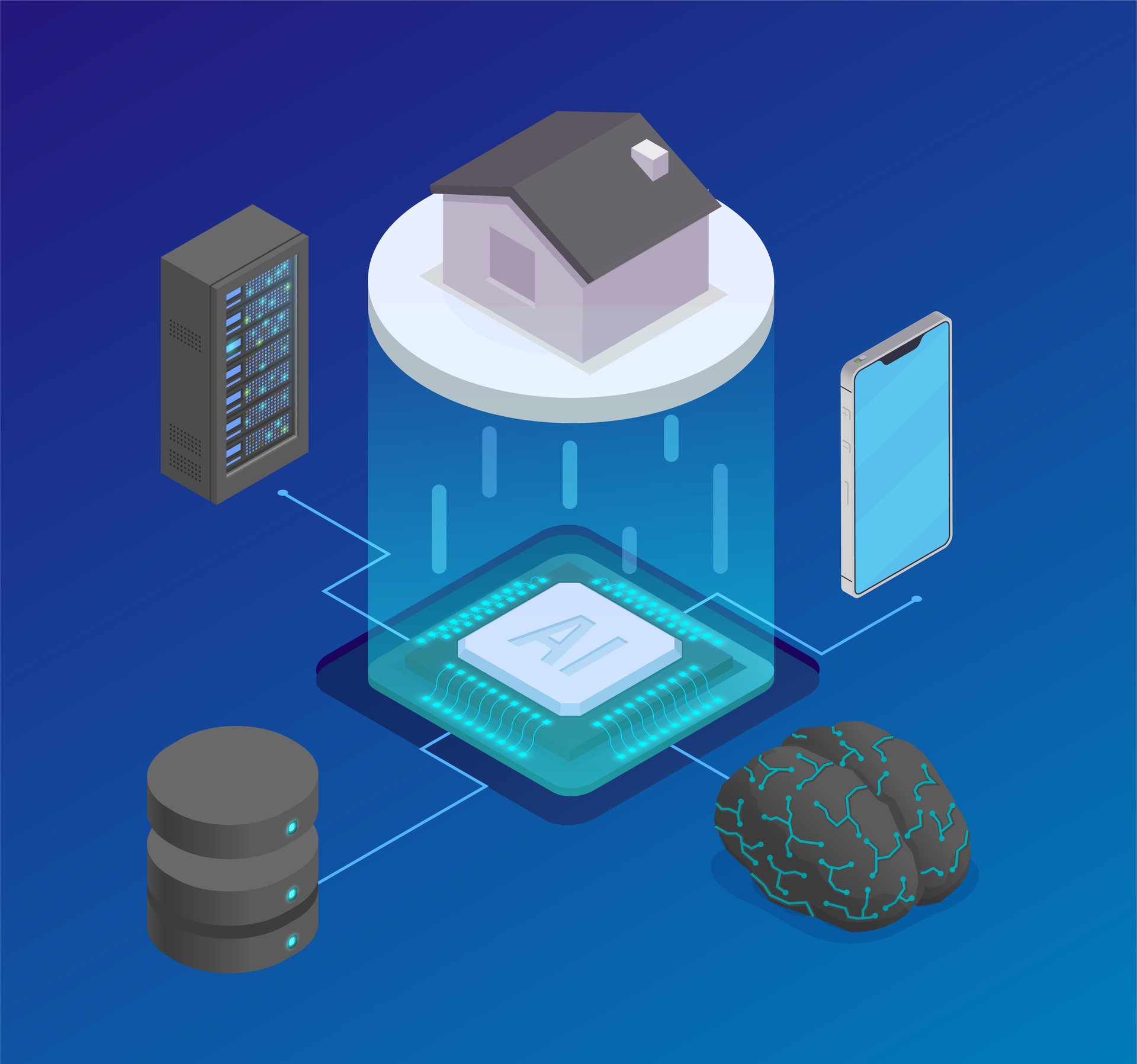
The foundation everything runs on. Cloud platforms configured for AI workloads. Vector databases for retrieval. Model deployment pipelines with version control and rollback. Monitoring that catches drift before your users do.
See the tech stack
Explore AI Options Powered by Organized Data
Generative AI
Chatbot & Virtual Assistant Deployment
NLP Workloads
Code Assist Tools
Content Generation & Review
Fraud Detection & Pattern Recognition
Computer Vision
Agentic AI
Autonomous Task Agents
Multi-Step Workflow Orchestration
Cross-System Decision Automation
Knowledge Base Retrieval (RAG)
Human Escalation Routing
Governed AI. Built to Protect.
Enterprise AI without governance is a liability. Models can leak sensitive data. AI-powered search can expose proprietary information to the open web. Without controls, your company’s most confidential data becomes discoverable.
We build every AI solution on enterprise-grade, closed deployments of OpenAI, Anthropic, and Google Gemini. Your data stays inside your perimeter. Your AI operates under rules you set. No public-model risks. No uncontrolled access.
Governance architecture differs by industry. Banking AI needs regulatory hard-coding for SOX, Basel III, and AML. Healthcare AI needs HIPAA-compliant data suppression and PHI boundaries. Casino AI needs responsible gambling controls and player data isolation. We design governance that matches your domain’s regulations, your data profile, and your risk tolerance.
Governed
Self-Regulation
Sovereign
Information Boundaries
Responsible
Audit-Ready Controls
Protected
Domain Compliance
Self-regulation. Information boundaries. Audit-ready controls. Domain-tailored compliance.
Every AI we deliver ships with these built in.
Explore AI Options Powered by Organized Data
Human in the Loop. By Design.
AI processes thousands of decisions per second. Some of those decisions need a person.
A lending approval that affects someone’s home. A medical flag that changes a treatment plan. A legal review that determines liability. A fraud alert that freezes an account.
We build human checkpoints into every AI workflow at the design stage. Your team reviews, adjusts, and approves at the moments that carry real consequences. We configure the confidence thresholds that determine what routes to a person and what processes automatically. And we train reviewers to catch what the model misses.
Here’s what most providers skip: putting a human in the loop does nothing if that human approves everything without scrutiny. Researchers call it automation bias. The EU AI Act, NIST AI RMF in North America, and emerging frameworks across regulated markets all require designing against it. We do. Our oversight architecture presents AI outputs in ways that require genuine review. We set review time expectations. We track approval rates as a health metric. We require structured justification for high-stakes decisions.
Speed where speed matters. Pause where judgment matters.
Decision Flow
- AI processes decision
- Confidence score evaluated
- High confidence: Auto-approved
- Low confidence: Human review
- Reviewer approves, adjusts, or rejects
- Decision logged with audit trail
Automated
Human
See how oversight works in practice
Why Most AI Investments Stall
88%
39%
That gap costs billions every year. The cause is almost never the algorithm.
McKinsey, 2025
10% of AI success comes from the model. 20% comes from infrastructure. The other 70% is people and process: data readiness, team training, governance, workflow redesign, and clear rules for who reviews what the AI produces.
We call this AI enablement. Every engagement starts with a readiness assessment before a single line of code. We evaluate your data quality, your team’s AI fluency, your governance gaps, and your integration landscape. Then we build, with oversight and adoption baked in from day one.
AI consulting that goes beyond strategy decks. AI development that goes beyond proof of concept.
AI Is Only as Good as Its Data
Related Case Studies

How an APAC Airline Cut Time-to-Hire by 45% With AI Workforce Management
FROM: Fragmented HR systems and manual compliance tracking. TO: AI-powered workforce planning with predictive staffing.

A Reliable Supply Chain for Critical Care
FROM: Poor inventory insight and delayed recalls. TO: Predictive supply management connecting manufacturers, distributors, and care networks securely. Fixing Critical Gaps in the Healthcare Supply Chain A healthcare network

Automated, Personalized Patient Journeys
FROM: Static portals and disconnected outreach. TO: Personalized, privacy-aware engagement built on a 360-degree, consent-based data model. Creating a Patient Experience That Actually Feels Personal A hospital group used
Ready to Accelerate Your AI Journey?
Book time with our team.
Technology Stack
Trusted by Enterprises That Care About Getting It Right
300+
8
19
30%
ISO 9001
ISO 27001
CMMI Level 5
2025 Inc. 5000
Need Answers? Find Them Here
- What types of AI solutions does Scadea build?We create chatbots, autonomous agents, code-assist tools, NLP workflows, fraud detection models, and computer-vision systems.
- How does Scadea keep enterprise AI secure?We follow zero-trust controls, do not use subcontractors, and design models with strict data-privacy boundaries.
- Can Scadea integrate AI into existing enterprise systems?Yes. Scadea integrates AI into existing CRMs, ERPs, cloud platforms, and custom applications using APIs, event-driven architectures, and secure data pipelines.
- What's the difference between generative AI and agentic AI in Scadea's work?Generative AI produces text, images, or code. Agentic AI takes action , driving tasks, automations, and workflows end-to-end.
- How fast can Scadea deliver AI projects?Our CMMI Level 5 processes and reusable frameworks let us deliver AI solutions faster and with predictable quality.
- Why do enterprises struggle to deploy AI at scale?Most struggle with data readiness, integration gaps, and security concerns. AI programs succeed when built on strong engineering discipline, governance, and domain-specific modeling.
- What makes agentic AI useful for enterprise workflows?Agentic AI doesn't just generate content , it completes tasks, triggers systems, and closes loops. This requires reliable integrations, process mapping, and robust automation frameworks.
- How do companies ensure AI models stay safe and compliant?Secure access controls, audit trails, model monitoring, and clear data boundaries are essential. Teams with security and compliance depth are better at implementing these safeguards.
- Why do most AI projects fail to reach production?Poor data quality, weak integration, and security issues slow deployment. Success comes from disciplined engineering and governance.
- How can enterprises safely adopt generative AI?Secure boundaries, strong access controls, and responsible model oversight keep data protected. Expert implementation reduces risk.
- What's the difference between automation and agentic AI?Automation follows rules; agentic AI can analyze data, make decisions, and trigger actions. Reliable agentic AI requires strong integration and workflow design.
- What data platforms does Scadea work with?Scadea builds on AWS, Azure, Google Cloud, and major on-prem ecosystems, enabling clients to modernize data environments with secure and scalable architectures.
- Does Scadea help create unified data pipelines?Yes. Scadea designs and builds ETL/ELT pipelines, streaming systems, and governed data layers that consolidate data from disparate enterprise systems.
- How does Scadea support data compliance and governance?We implement data lineage, access controls, auditability measures, and privacy safeguards aligned with PCI, HIPAA, GDPR, and other regulatory frameworks.
- Can Scadea improve business reporting and dashboards?Yes. We build business intelligence dashboards, predictive analytics solutions, and self-service analytics tools to give leaders faster, more accurate insights.
- How does Scadea handle big-data workloads?We support distributed processing, real-time streaming systems, and high-volume data pipelines. Our architectures scale to handle machine learning and operational analytics workloads securely and efficiently.
- Why is unified data important for modern businesses?Unified data reduces manual reporting, improves accuracy, and powers advanced analytics. Organizations benefit most when pipelines, governance, and architecture are built properly from the start.
- How does strong data governance improve decision-making?Governance ensures data quality, lineage, and trust. This makes analytics more reliable and reduces compliance risk.
- What enables real-time analytics at scale?Real-time insights depend on streaming architectures, optimized pipelines, and event-driven systems. Consistent engineering practices make these systems predictable and stable.
- Why is unified data critical for analytics and reporting?Without a single source of truth, insights are inconsistent and slow. Clean pipelines and solid governance fix this.
- How can companies move from manual reporting to real-time dashboards?Streaming data, cloud warehouses, and automated pipelines enable live insights. Consistent engineering makes these systems dependable.
- What's the best way to ensure data quality at scale?Data validation, lineage tracking, and governance frameworks keep data trustworthy. Expert teams help put these foundations in place.


Named technology partnerships with Salesforce, Oracle, AWS, Azure, Google Cloud, Databricks, Snowflake