How most people experience generative AI today.
- Public models, shared infrastructure
- Generic training data
- No governance
- No human review
- "It usually works"
Large language models, chatbots, and content generation built for enterprise workflows. Deployed inside your perimeter, trained on your data, and increasingly wired into agentic workflows that act on the output instead of handing it back to a human.




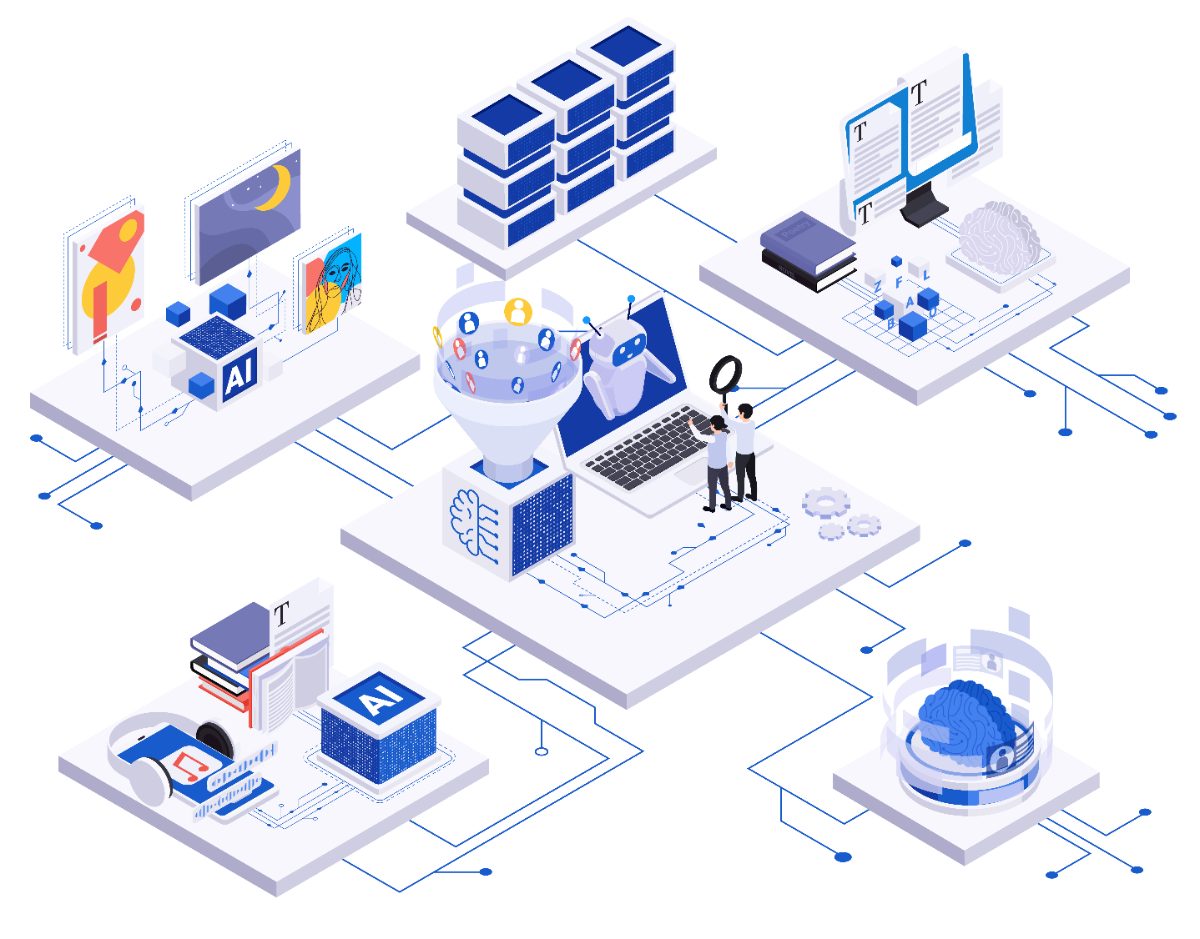
Generative AI had its enterprise moment as chatbots, content drafters, and code assistants. Useful and obvious. A human asks, the model responds, the human takes the output.
The next step is different. Enterprises want AI that moves the work forward on its own: schedule the follow-up, update the system, verify the data across applications, escalate the exception. That is agentic AI. Generative AI is the component that lives inside it, handling the language-reasoning parts.
Generative AI still matters. It is just not the whole story anymore. The governance, the deployment architecture, and the human oversight layer around it are what make it safe, and what make it ready to plug into an agentic workflow.

A human asks. The model responds. The human takes the output and does the next step. Useful, but passive.
The agent verifies data, updates the record, escalates the exception. Gen AI handles the language-reasoning. The agent owns the workflow.
The difference isn't the model. It's the governance, the deployment architecture, and the human oversight wrapped around it. That's what makes it safe to embed inside an agent.
Omni-channel deployment across web, mobile, Teams, Slack, and voice. Bot optimization for accuracy and resolution rate. Voice-integrated bots for call-center augmentation. Every assistant trained on your data, governed by your rules, and monitored for quality.
Document summarization that reduces a 40-page report to key findings. Classification that routes incoming content to the right team. Extraction that pulls structured data from unstructured documents. Sentiment analysis tuned for your industry's language and context.
AI-assisted development workflows that accelerate delivery without sacrificing quality. Code generation for boilerplate and repetitive patterns. Automated code review that flags bugs and security issues. Documentation generation from existing codebases. Human approval gates on every AI-generated commit.
First-draft generation for marketing, legal, and operational content. Compliance review that flags regulatory language issues before publication. Template-based generation that maintains brand voice and consistency. Every output goes through human review before it's published or sent.
Real-time anomaly detection across transaction data streams. Pattern recognition that identifies suspicious behavior across accounts and time windows. Confidence-scored alerts that route to human investigators based on severity. Reduces false positive rates while catching real threats faster.
Image classification for manufacturing quality inspection. Object detection for inventory management and safety compliance. Healthcare imaging analysis with physician review gates. Document processing that extracts data from scanned forms, IDs, and receipts.
Your data never touches public infrastructure.
We track hallucination rates, accuracy, and relevance.
High-stakes outputs route to a person before they take effect.
The AI only retrieves what the user is authorized to see.
Every prompt, every response, every decision logged and traceable.
The question isn't "Which LLM?" It's "What does the agent around the LLM do for my business?" See how we build autonomous agents with governed generative AI at their core.

Start with a readiness assessment. We evaluate your data, your governance gaps, your highest-value use cases, and where generative AI connects to the agentic workflows that actually move your business.
Yes, when deployed correctly. Enterprise-grade generative AI uses closed LLM deployments, data access controls, and human review workflows. We design these safeguards into every solution for BFSI, healthcare, gaming, manufacturing, and transportation clients.
Generative AI entered enterprises as chatbots and content tools. Useful, but passive. The human had to prompt every step. Enterprises now want AI that acts: verify the data across systems, update the record, escalate the exception. Generative AI is still part of that, but as a component inside the agent, not the endpoint.
Generative AI creates outputs (text, code, images) from prompts. Agentic AI plans and executes multi-step tasks autonomously within defined boundaries. Every agent we build uses generative models inside. The agent is the architecture around the model.
Fine-tuning on domain-specific data, RAG systems that ground outputs in your actual data, output quality monitoring, and human review gates for high-stakes decisions. No model is perfect. The safeguards catch what the model misses.
Yes. We build connectors for Salesforce, ServiceNow, Oracle, Microsoft 365, and custom platforms. The AI embeds into your existing workflows.